3. California Regional Model
3.1. Overview
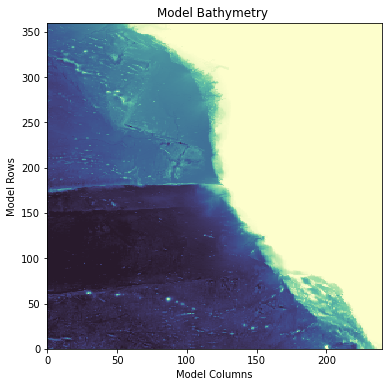
This regional model is constructed in the eastern Pacific Ocean and encompasses most of the California current region. This model is constructed to run during the year 2008 and is initiated and forced with output from the ECCO Version 5 Alpha State Estimate. The domain of the regional model is shown in the following plot:
3.1.1. eccoseas modules
The construction of this model showcases many of the components of the eccoseas package in the downscale and ecco modules. These modules are used in this demo to complete the following list of tasks:
Bathymetry “filling” to remove isolated regions
Reading the ECCO grid
Reading ECCO Version 5 output fields
Reading ECCO external forcing fields
Interpolating 2D and 3D fields to a regional domain for initial, external, and boundary conditions
3.1.2. Required ECCO Data
For this example, the following list of files are required from the ECCO Version 5 Alpha State estimate. These files are available on the ECCO drive.
Variable |
File(s) |
|---|---|
Potential Temperature |
THETA_2007.nc, THETA_2008.nc, THETA_2009.nc |
Salinity |
SALT_2007.nc, SALT_2008.nc, SALT_2009.nc |
u-Component of Velocity |
UVELMASS_2007.nc, UVELMASS_2008.nc, UVELMASS_2009.nc |
v-Component of Velocity |
VVELMASS_2007.nc, VVELMASS_2008.nc, VVELMASS_2009.nc |
Sea Surface Height Anomaly |
ETAN_2007.nc, ETAN_2008.nc, ETAN_2009.nc |
Lowngwave Downwelling Radiation |
EIG_dlw_plus_ECCO_v4r1_ctrl_2008 |
Shortwave Downwelling Radiation |
EIG_dsw_plus_ECCO_v4r1_ctrl_2008 |
u-Component of Wind |
EIG_u10m_2008 |
v-Component of Wind |
EIG_v10m_2008 |
Precipitation |
EIG_rain_plus_ECCO_v4r1_ctrl_2008 |
Air Temperature |
EIG_tmp2m_degC_plus_ECCO_v4r1_ctrl_2008 |
Specific Humidity |
EIG_spfh2m_plus_ECCO_v4r1_ctrl_2008 |
Grid components for each tile |
GRID.0001.nc through GRID.0013.nc |
3.1.3. Configuration Files
The model configuration files for this regional model are provided in the configurations directory of the eccoseas Github repository.
The following sections showcase the construction of the input binaries for the model.
3.2. Model Grid
3.3. Bathymetry
3.4. Initial Conditions
- 3.4.1. Constructing the Initial Conditions
- 3.4.1.1. Step 1: Download the ECCO fields
- 3.4.1.2. Step 2: Read in the ECCO grid
- 3.4.1.3. Step 3: Read in the Model Grid and Generate a Mask
- 3.4.1.4. Step 4: Prepare the grids for interpolation
- 3.4.1.5. Step 5: Interpolate the Fields onto the Model Grid
- 3.4.1.6. Step 6: Plotting the Initial Condition Fields
- 3.4.1.7. Step 7: Run-time considerations