This notebook is used to demonstrate the creation of the initial conditions for the North Atlantic regional model.
The approach in this notebook is similar to the notebook for the California regional model except for two key differences:
Seaice variables are included in this procedure
No assumption is made regarding the orientation of the grid for vector properties (i.e. the vector quantities will be rotated from their orientation in the ECCO grid to the orientation of the curvilinear grid of the regional model).
First, import packages to create and visualize the model fields here:
[1]:
# import the modules for computation, plotting, and reading files
import os
import numpy as np
import matplotlib.pyplot as plt
import netCDF4 as nc4
import cmocean.cm as cm

# import the necessary modules from eccoseas
from eccoseas.ecco import io
from eccoseas.ecco import grid as eeg
from eccoseas.downscale import hFac
from eccoseas.downscale import horizontal
4.2.1. Constructing the Initial Conditions
The initial conditions for this model will be generated by interpolating from a model state from the ECCO Version 5 state estimate using the eccoseas tools.
This construction will proceed in 6 steps:
download the pertinent ECCO fields
read the ECCO model grid
read in the bathymetry for the regional model as well as its grid
prepare the ECCO fields for interpolation
interpolate the ECCO fields onto the regional model grid and store each as a binary file
plot the interpolated fields to ensure they look as expected
4.2.1.1. Step 1: Download the ECCO fields
To begin, we downloaded the model fields generated by the ECCO Version 5 Alpha state estimate. These fields are available HERE. For the initial conditions, we use fields from 1992, which are listed here:
Variable |
File Name |
|---|---|
THETA |
THETA/THETA_1992.nc |
SALT |
SALT/SALT_1992.nc |
UVEL |
UVELMASS/UVELMASS_1992.nc |
VVEL |
VVELMASS/VVELMASS_1992.nc |
ETAN |
ETAN/ETAN_1992.nc |
SIuice |
SIuice/SIuice_1992.nc |
SIvice |
SIuice/SIvice_1992.nc |
SIheff |
SIheff/SIheff_1992.nc |
SIhsnow |
SIhsnow/SIhsnow_1992.nc |
SIarea |
SIarea/SIarea_1992.nc |
As described in the Overview, we stored these in individual directories for each variable in the following directory:
[2]:
data_folder = '../../../data/north_atlantic'
4.2.1.2. Step 2: Read in the ECCO grid
To read in the ECCO fields, we use the io module from the eccoseas.ecco package:
[3]:
ecco_XC_tiles = io.read_ecco_grid_tiles_from_nc(os.path.join(data_folder, 'GRID'), var_name='XC')
ecco_YC_tiles = io.read_ecco_grid_tiles_from_nc(os.path.join(data_folder, 'GRID'), var_name='YC')
ecco_AngleCS_tiles = io.read_ecco_grid_tiles_from_nc(os.path.join(data_folder, 'GRID'), var_name='AngleCS')
ecco_AngleSN_tiles = io.read_ecco_grid_tiles_from_nc(os.path.join(data_folder, 'GRID'), var_name='AngleSN')
ecco_hFacC_tiles = io.read_ecco_grid_tiles_from_nc(os.path.join(data_folder, 'GRID'), var_name='hFacC')
ecco_hFacW_tiles = io.read_ecco_grid_tiles_from_nc(os.path.join(data_folder, 'GRID'), var_name='hFacW')
ecco_hFacS_tiles = io.read_ecco_grid_tiles_from_nc(os.path.join(data_folder, 'GRID'), var_name='hFacS')
ecco_RF_tiles = io.read_ecco_grid_tiles_from_nc(os.path.join(data_folder, 'GRID'), var_name='RF')
ecco_DRF_tiles = io.read_ecco_grid_tiles_from_nc(os.path.join(data_folder, 'GRID'), var_name='DRF')
Note here that we have read in two additional fields which were not used in the previous model construction: AngleCS and AngleSN. These fields will be important for rotating vector quantities at locations near the poles.
As described HERE, the ECCO grid has 13 tiles but only a few may pertain to the local area. To determine which tiles correspond to the region, I’ll read in my model grid next.
4.2.1.3. Step 3: Read in the Model Grid and Generate a Mask
Here, I will read in the regional model grid and read in the bathymetry file (see previous notebooks for details):
[4]:
# define the input directory (see previous notebook for details)
input_dir = '../../../configurations/north_atlantic/input'
[5]:
# read in the grids that will be used in the model
ds = nc4.Dataset(os.path.join(input_dir,'north_atlantic_grid.nc'))
XC = ds.variables['XC'][:,:]
YC = ds.variables['YC'][:,:]
bathy = -1*ds.variables['Depth'][:,:]
AngleCS = ds.variables['AngleCS'][:,:]
AngleSN = ds.variables['AngleSN'][:,:]
hFacC = ds.variables['HFacC'][:,:,:]
hFacS = ds.variables['HFacS'][:,:,:]
hFacW = ds.variables['HFacW'][:,:,:]
delR = ds.variables['drF'][:]
ds.close()

# remove the extra row and col from hFacS and hFacW
hFacS = hFacS[:,:-1,:]
hFacW = hFacW[:,:,:-1]
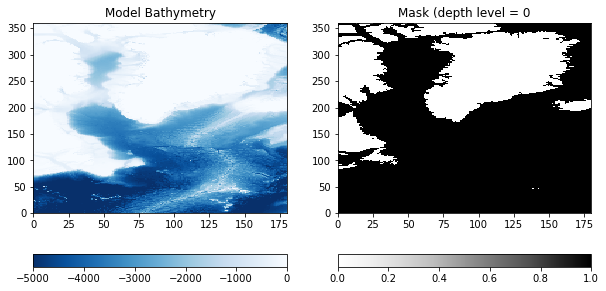
The mask is generated by setting all of the non-zero hFac points to 1:
[6]:
# generate the masks
maskC = np.copy(hFacC)
maskC[maskC>0] = 1

maskS = np.copy(hFacS)
maskS[maskS>0] = 1

maskW = np.copy(hFacW)
maskW[maskW>0] = 1
To double check the mask was created as expected, I will plot it in comparison to the bathymetry here:
[7]:
plt.figure(figsize=(10,5))

plt.subplot(1,2,1)
C = plt.pcolormesh(bathy, vmin=-5000, vmax=0, cmap='Blues_r', shading='auto')
plt.colorbar(C, orientation = 'horizontal')
plt.title('Model Bathymetry')

depth_level = 0
plt.subplot(1,2,2)
C = plt.pcolormesh(maskC[0, :, :], vmin=0, vmax=1, cmap='Greys', shading='auto')
plt.colorbar(C, orientation = 'horizontal')
plt.title('Mask (depth level = '+str(depth_level))

plt.show()
4.2.1.4. Step 4: Prepare the grids for interpolation
At this point, we can use the geometry of both grids to check to see which tiles have the information we need. After referencing the ECCO geometry, I find that tiles 3, 7, and 11 have the points we need:
[8]:
# formulate the tile list
tile_list = [3, 7, 11]

# plot the ECCO tile points from the specified tiles
for tile in tile_list:
    plt.plot(ecco_XC_tiles[tile],ecco_YC_tiles[tile],'k.')

# plot the ECCO tile points from tiles 3, 7 and 11
plt.plot(ecco_XC_tiles[11],ecco_YC_tiles[11],'k.')
plt.plot(ecco_XC_tiles[7],ecco_YC_tiles[7],'k.')
plt.plot(ecco_XC_tiles[3],ecco_YC_tiles[3],'k.')

# plot the boundary of the CA model
plt.plot(XC[:,0],YC[:,0], 'g-')
plt.plot(XC[:,-1],YC[:,-1], 'g-')
plt.plot(XC[0,:],YC[0,:], 'g-')
plt.plot(XC[-1,:],YC[-1,:], 'g-')

plt.xlabel('Longitude')
plt.ylabel('Latitude')
plt.show()
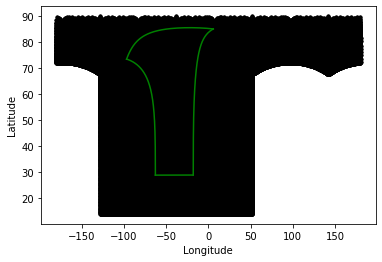
As we can see, the model boundary (green) is completely surrounded by the points in tiles 3, 7, and 11 (black). Let’s read in the grid information from these tiles:
[9]:
# the tile list
tile_list = [3,7,11]

# determine the number of points in each set
total_points = 0
for tile_number in tile_list:
    total_points += np.size(ecco_XC_tiles[tile_number])

# make empty arrays to fill in
ecco_XC_points = np.zeros((total_points, ))
ecco_YC_points = np.zeros((total_points, ))
ecco_AngleCS_points = np.zeros((total_points, ))
ecco_AngleSN_points = np.zeros((total_points, ))
ecco_maskC_points = np.zeros((np.size(ecco_RF_tiles[1]) , total_points))
ecco_maskW_points = np.zeros((np.size(ecco_RF_tiles[1]) , total_points))
ecco_maskS_points = np.zeros((np.size(ecco_RF_tiles[1]) , total_points))
ecco_hFacW_points = np.zeros((np.size(ecco_RF_tiles[1]) , total_points))
ecco_hFacS_points = np.zeros((np.size(ecco_RF_tiles[1]) , total_points))

# loop through the tiles and fill in the XC, YC, and mask points for interpolation
points_counted = 0
for tile_number in tile_list:
    tile_N = np.size(ecco_XC_tiles[tile_number])

    ecco_XC_points[points_counted:points_counted+tile_N] = ecco_XC_tiles[tile_number].ravel()
    ecco_YC_points[points_counted:points_counted+tile_N] = ecco_YC_tiles[tile_number].ravel()

    ecco_AngleCS_points[points_counted:points_counted+tile_N] = ecco_AngleCS_tiles[tile_number].ravel()
    ecco_AngleSN_points[points_counted:points_counted+tile_N] = ecco_AngleSN_tiles[tile_number].ravel()

    for k in range(np.size(ecco_RF_tiles[tile_number])):
        level_hFacC = ecco_hFacC_tiles[tile_number][k, :, :]
        if tile_number<7:
            level_hFacW = ecco_hFacW_tiles[tile_number][k, :, :]
            level_hFacS = ecco_hFacS_tiles[tile_number][k, :, :]
        else:
            level_hFacS = ecco_hFacW_tiles[tile_number][k, :, :] # these are switched due to the
            level_hFacW = ecco_hFacS_tiles[tile_number][k, :, :] # assumptions about velocity - see note below
        ecco_hFacW_points[k, points_counted:points_counted+tile_N] = level_hFacW.ravel()
        ecco_hFacS_points[k, points_counted:points_counted+tile_N] = level_hFacS.ravel()
        level_maskC = np.copy(level_hFacC)
        level_maskC[level_maskC>0] = 1
        level_maskW = np.copy(level_hFacW)
        level_maskW[level_maskW>0] = 1
        level_maskS = np.copy(level_hFacS)
        level_maskS[level_maskS>0] = 1
        ecco_maskC_points[k, points_counted:points_counted+tile_N] = level_maskC.ravel()
        ecco_maskW_points[k, points_counted:points_counted+tile_N] = level_maskW.ravel()
        ecco_maskS_points[k, points_counted:points_counted+tile_N] = level_maskS.ravel()

    points_counted += tile_N
Next, we’ll read in the real data fields and apply the modifications. First, create a dictionary to store the file names:
[10]:
# make a file dictionary to loop over
file_prefix_dict = {'ETAN':'ETAN_1992.nc',
                    'THETA':'THETA_1992.nc',
                    'SALT':'SALT_1992.nc',
                    'SIarea':'SIarea_1992.nc',
                    'SIheff':'SIheff_1992.nc',
                    'SIhsnow':'SIhsnow_1992.nc',
                    'SIuice':'SIuice_1992.nc',
                    'SIvice':'SIvice_1992.nc',
                    'UVEL':'UVELMASS_1992.nc',
                    'VVEL':'VVELMASS_1992.nc'}

variable_names = list(file_prefix_dict.keys())
Now, read the initial condition fields from the same tiles:
[11]:
# make a list to hold all of the ECCO grids
init_grids = []

# loop through each variable to read in the grid
for variable_name in variable_names:

    print('Reading in the data for '+str(variable_name))

    if variable_name == 'ETAN' or variable_name in ['SIarea','SIheff','SIhsnow']:
        ds = nc4.Dataset(os.path.join(data_folder,variable_name,file_prefix_dict[variable_name]))
        grid = ds.variables[variable_name][:,:,:,:]
        ds.close()
        grid = grid[0, :, :, :] # first timestep (january)
    elif 'VEL' in variable_name:
        ds = nc4.Dataset(os.path.join(data_folder,'UVELMASS','UVELMASS_1992.nc'))
        u_grid = ds.variables['UVELMASS'][:,:,:,:,:]
        ds.close()
        u_grid = u_grid[0, :, :, :, :] # first timestep (january)
        ds = nc4.Dataset(os.path.join(data_folder,'VVELMASS','VVELMASS_1992.nc'))
        v_grid = ds.variables['VVELMASS'][:,:,:,:,:]
        ds.close()
        v_grid = v_grid[0, :, :, :, :] # first timestep (january)
    elif 'ice' in variable_name:
        ds = nc4.Dataset(os.path.join(data_folder,'SIuice','SIuice_1992.nc'))
        u_grid = ds.variables['SIuice'][:,:,:,:]
        ds.close()
        u_grid = u_grid[0, :, :, :] # first timestep (january)
        ds = nc4.Dataset(os.path.join(data_folder,'SIvice','SIvice_1992.nc'))
        v_grid = ds.variables['SIvice'][:,:,:,:]
        ds.close()
        v_grid = v_grid[0, :, :, :] # first timestep (january)
    else:
        ds = nc4.Dataset(os.path.join(data_folder,variable_name,file_prefix_dict[variable_name]))
        grid = ds.variables[variable_name][:,:,:,:,:]
        ds.close()
        grid = grid[0, :, :, :, :] # first timestep (january)

    # rotate grids, if needed
    if 'VEL' in variable_name:
        grid = np.zeros_like(u_grid)
        for tile_number in tile_list:
            zonal_grid, meridional_grid = eeg.rotate_ecco_vel_grids_to_natural_grids(u_grid[:,tile_number-1,:,:], v_grid[:,tile_number-1,:,:],
                                                                                 ecco_AngleCS_tiles[tile_number], ecco_AngleSN_tiles[tile_number])
            if variable_name=='UVEL':
                grid[:,tile_number-1,:,:] = zonal_grid
            if variable_name=='VVEL':
                grid[:,tile_number-1,:,:] = meridional_grid
    if 'ice' in variable_name:
        grid = np.zeros_like(u_grid)
        for tile_number in tile_list:
            zonal_grid, meridional_grid = eeg.rotate_ecco_vel_grids_to_natural_grids(u_grid[tile_number-1,:,:], v_grid[tile_number-1,:,:],
                                                                                 ecco_AngleCS_tiles[tile_number], ecco_AngleSN_tiles[tile_number], has_depth=False)
            if variable_name=='SIuice':
                grid[tile_number-1,:,:] = zonal_grid
            if variable_name=='SIvice':
                grid[tile_number-1,:,:] = meridional_grid

    # create a grid of zeros to fill in
    N = np.shape(grid)[-1]*np.shape(grid)[-2]
    if variable_name == 'ETAN'  or variable_name in ['SIarea','SIheff','SIhsnow','SIuice','SIvice']:
        init_grid = np.zeros((1, N*len(tile_list)))
    else:
        init_grid = np.zeros((np.size(ecco_RF_tiles[1]), N*len(tile_list)))

    # loop through the tiles
    points_counted = 0
    for tile_number in tile_list:
        if variable_name in ['ETAN','SIarea','SIheff','SIhsnow','SIuice','SIvice']:
            init_grid[0, points_counted:points_counted+N] = \
                 grid[tile_number-1, :, :].ravel()
        else:
            for k in range(np.size(ecco_RF_tiles[1])):
                init_grid[k,points_counted:points_counted+N] = \
                     grid[k, tile_number-1, :, :].ravel()
        points_counted += N

    # apply some corrections to convert UVELMASS and VVELMASS to UVEL and VVEL
    if variable_name == 'UVEL':
        for k in range(np.size(ecco_RF_tiles[1])):
            non_zero_indices = ecco_hFacW_points[k,:]!=0
            init_grid[k,non_zero_indices] = init_grid[k,non_zero_indices]/(ecco_hFacW_points[k,non_zero_indices])
    if variable_name == 'VVEL':
        for k in range(np.size(ecco_RF_tiles[1])):
            non_zero_indices = ecco_hFacS_points[k,:]!=0
            init_grid[k,non_zero_indices] = init_grid[k,non_zero_indices]/(ecco_hFacS_points[k,non_zero_indices])

    init_grids.append(init_grid)
Reading in the data for ETAN
Reading in the data for THETA
Reading in the data for SALT
Reading in the data for SIarea
Reading in the data for SIheff
Reading in the data for SIhsnow
Reading in the data for SIuice
Reading in the data for SIvice
Reading in the data for UVEL
Reading in the data for VVEL
4.2.1.5. Step 5: Interpolate the Fields onto the Model Grid
Next, we will interpolate the ECCO external fields I read in onto my model domain. As before, we will use the horizontal module from the eccoseas package to accomplish this interpolation.
[12]:
# keep a copy of the vector grid information
# because we're going to rotate them after
vector_grids = {}

# loop through each variable and corresponding ECCO grid
for variable_name, init_grid in zip(variable_names, init_grids):

    # print a message to keep track of which variable we are working on
    print('    - Interpolating the '+variable_name+' grid')

    # read in the correct mask for each variable
    if variable_name == 'ETAN':
        regional_mask = maskC[:1,:,:]
        ecco_mask = ecco_maskC_points[:1,:]
    elif variable_name == 'UVEL' or variable_name=='SIuice':
        regional_mask = maskW
        ecco_mask = ecco_maskW_points
    elif variable_name == 'VVEL' or variable_name=='SIvice':
        regional_mask = maskS
        ecco_mask = ecco_maskS_points
    else:
        regional_mask = maskC
        ecco_mask = ecco_maskC_points

    if 'SI' in variable_name:
        regional_mask = regional_mask[:1,:,:]
        interpolated_grid = horizontal.downscale_3D_points(np.column_stack([ecco_XC_points, ecco_YC_points]),
                                                           init_grid, ecco_mask,
                                                           XC, YC, regional_mask, remove_zeros=False)
    else:
        interpolated_grid = horizontal.downscale_3D_points(np.column_stack([ecco_XC_points, ecco_YC_points]),
                                                           init_grid, ecco_mask,
                                                           XC, YC, regional_mask)

    # raising EtaN by 1 m for numerical stability
    if variable_name == 'ETAN':
        interpolated_grid[interpolated_grid!=0]+=1

    # output if the grid is a tracer grid, otherwise keep a copy for rotation
    if variable_name in ['SIuice','SIvice','UVEL','VVEL']:
        vector_grids[variable_name] = interpolated_grid
    else:
        # output the interpolated grid
        output_file = os.path.join(input_dir,variable_name+'_IC.bin')
        interpolated_grid.ravel('C').astype('>f4').tofile(output_file)

# now, rotate the the vector grids to the curvilinear domain of the model
if 'SIuice' in variable_names and 'SIvice' in variable_names:
    SIuice, SIvice = eeg.rotate_vel_grids_to_domain(vector_grids['SIuice'], vector_grids['SIvice'], AngleCS, AngleSN)
    SIuice.ravel('C').astype('>f4').tofile(os.path.join(input_dir,'SIuice_IC.bin'))
    SIvice.ravel('C').astype('>f4').tofile(os.path.join(input_dir,'SIvice_IC.bin'))
if 'UVEL' in variable_names and 'VVEL' in variable_names:
    uvel, vvel = eeg.rotate_vel_grids_to_domain(vector_grids['UVEL'], vector_grids['VVEL'], AngleCS, AngleSN)
    uvel.ravel('C').astype('>f4').tofile(os.path.join(input_dir,'UVEL_IC.bin'))
    vvel.ravel('C').astype('>f4').tofile(os.path.join(input_dir,'VVEL_IC.bin'))
    - Interpolating the ETAN grid
    - Interpolating the THETA grid
    - Interpolating the SALT grid
    - Interpolating the SIarea grid
    - Interpolating the SIheff grid
    - Interpolating the SIhsnow grid
    - Interpolating the SIuice grid
    - Interpolating the SIvice grid
    - Interpolating the UVEL grid
    - Interpolating the VVEL grid
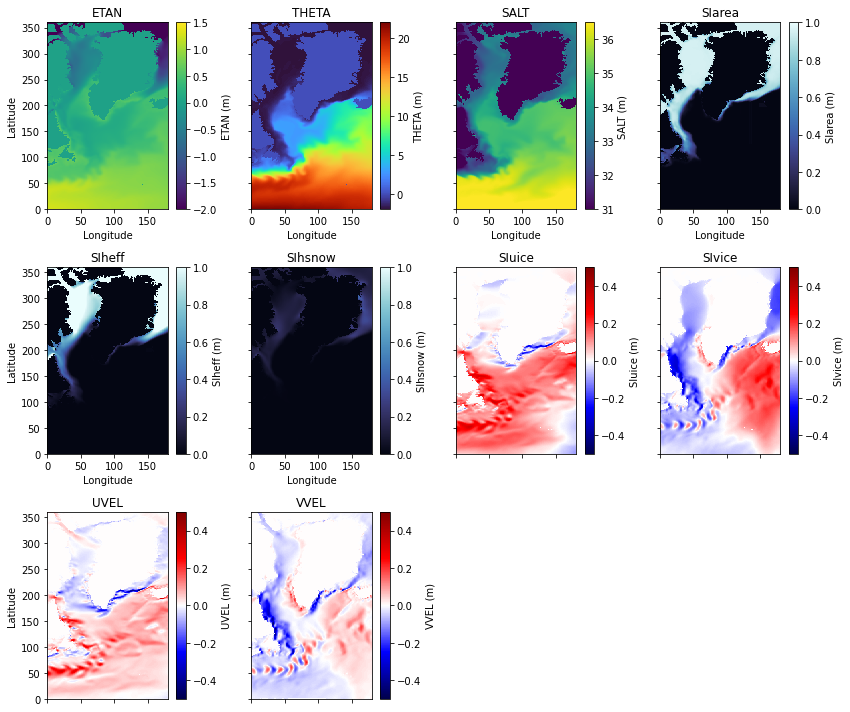
4.2.1.6. Step 6: Plotting the Initial Condition Fields
Now that the fields have been generated, I will plot them to ensure they look as expected. First, I’ll generate some metadata for each one:
[13]:
meta_dict = {'ETAN':[-2, 1.5, 'viridis', 'm'],
            'THETA':[-2,22, 'turbo', 'm'],
            'SALT':[31, 36.5, 'viridis', 'm'],
            'UVEL':[-0.5, 0.5, 'seismic', 'm'],
            'VVEL':[-0.5, 0.5, 'seismic', 'm'],
            'SIarea':[0,1, cm.ice, 'm'],
             'SIhsnow':[0,1, cm.ice, 'm'],
             'SIheff':[0,1, cm.ice, 'm'],
            'SIuice':[-0.5, 0.5, 'seismic', 'm'],
            'SIvice':[-0.5, 0.5, 'seismic', 'm']}
Then, I’ll create all of the subplots:
[14]:
fig = plt.figure(figsize=(12,10))


for i in range(len(variable_names)):
    variable_name = variable_names[i]

    NA_init_grid = np.fromfile(os.path.join(input_dir,variable_name+'_IC.bin'),'>f4')

    if variable_name == 'ETAN' or 'SI' in variable_name:
        NA_init_grid = NA_init_grid.reshape((np.shape(XC)[0], np.shape(XC)[1]))
    else:
        NA_init_grid = NA_init_grid.reshape((np.shape(delR)[0],np.shape(XC)[0], np.shape(XC)[1]))
        NA_init_grid = NA_init_grid[0, :, :] # choose just the surface for plotting

    vmin = np.min(NA_init_grid[NA_init_grid!=0])
    vmax = np.max(NA_init_grid[NA_init_grid!=0])

    plt.subplot(3,4,i+1)
    C = plt.pcolormesh(NA_init_grid,
                       vmin=meta_dict[variable_names[i]][0],
                       vmax=meta_dict[variable_names[i]][1],
                       cmap=meta_dict[variable_names[i]][2],
                      shading='auto')
    plt.colorbar(C, label=variable_names[i]+' ('+meta_dict[variable_names[i]][3]+')',fraction=0.26)

    if i>5:
        plt.gca().set_xticklabels([])
    else:
        plt.gca().set_xlabel('Longitude')
    if i%4!=0:
        plt.gca().set_yticklabels([])
    else:
        plt.gca().set_ylabel('Latitude')
    plt.title(variable_name)

plt.tight_layout()

plt.show()
Next up, we’ll provide some notes on the external forcing conditions and then move on to the boundary conditions.
hydrogThetaFile = 'THETA_IC.bin',
hydrogSaltFile = 'SALT_IC.bin',
uVelInitFile = 'UVEL_IC.bin',
vVelInitFile = 'VVEL_IC.bin',
pSurfInitFile = 'ETAN_IC.bin',